
Insights 22 October 2026 A Conversation with Jo-Anne Gardener Security Project Support Manager, LMS Security Advisors Behind every successful deployment at LMS Security Advisors is a meticulous framework of security precision and team alignment. It relies on seamless support and continuous governance to transition complex security designs into flawless realities. Steering this operational engine is Jo-Anne Gardener, who channels decades of frontline industry expertise into her role as Security Project Support Manager. Celebrating a five-year milestone with the firm, Jo serves as a critical link between high-level initiatives and ground-level execution, continuously refining workflows and elevating how the team collaborates under pressure. We caught up with Jo to dissect her five years at LMS, exploring how she manages complex project ecosystems and what it takes to sustain security velocity in a rapidly evolving sector. Project support brings structure, visibilty and clarity so teams can focus on deliver. Jo-Anne Gardener 1. To start, could you give us a brief overview of your journey into the security side of LMS, and what a typical day looks like for you as Security Project Manager? My journey has focused on coordination, organisation and communication to help teams deliver projects successfully. A typical day involves reviewing priorities, deadlines and issues, then coordinating with project managers, teams and stakeholders. I maintain documentation, track actions, organise meetings and help the team adapt when priorities change. For me, project support brings structure, visibility and clarity so teams can focus on delivery. 2. Given your decades of experience in the security sector, think back to a traditional industry habit you used to see everywhere. What was it, and why did it have to be broken to thrive in today’s modern LMS Security ecosystem? One traditional habit was relying heavily on manual processes and doing things because that’s how we have always done it. LMS has done a great job of embracing technology, improving processes and encouraging people to work smarter. That has made us efficient, responsive and connected. For me, its about respecting what worked in the past while always looking for better ways to support our teams and clients. 3. A blueprint prepares us to thrive in a dynamic, client-facing environment. How do you maintain operational control when a client’s security requirements suddenly shift at the eleventh hour? When requirements change at short notice, I first confirm what has changed and assess the impact on plans, deadlines, resources and actions. I then work with the Project Manager and teams to reprioritise, update responsibilities and document the change clearly. Have clear communication with internal stakeholders and manage expectations, escalate risks early and assist with keeping the delivery controlled. 4. As the Support Project Manager, what is the process you follow to break down a security strategy into simple, daily workflows for the team? I start by understanding the overall objective, then break it into milestones, deliverables and actions. I work with the Project Manager and team to assign owners, deadlines and dependencies. Making actions clear through trackers and providing clear updates. Day to day, I manage priorities, monitor blockers and escalate issues. 5. Given the rapid advancement of technology and Artificial Intelligence, how do you balance immediate technological integration with long-term project scalability? I see technology and AI as useful when it solves a real problem. Before adopting anything new, I consider efficiency. The aim is to improve processes without adding complication. 6. A great security strategy is only as strong as the people who adopt it. How do you engage and inspire teams to fully embrace new security protocols right from day one? Successful adoption starts with clear communication and leading by example. People are more likely to embrace a new protocol when they understand why it matters and how it benefits the project. I would make the process clear, practical and easy to follow, with clear responsibilities and guidance. I monitor and address issues quickly and gather feedback. For me, change succeeds when people understand it, feel supported and can apply it easily. 7. Let’s look at your five-year milestone with LMS Security Advisors. What is that one advice you would offer professionals on leading security operations across cross-functional teams? My advice would be to communicate clearly, build strong relationships and keep everyone focused on the same goal. As a Project Support Manager, I believe in staying organised, tacking actions, dealing with issues early and making sure people have the information they need. You don’t always need authority to lead. Being reliable, supportive and organised can have just as much impact and helps the team succeed. This is the first in the series, with more conversations with the LMS Security Advisors team coming soon. Stay tuned for the next one.
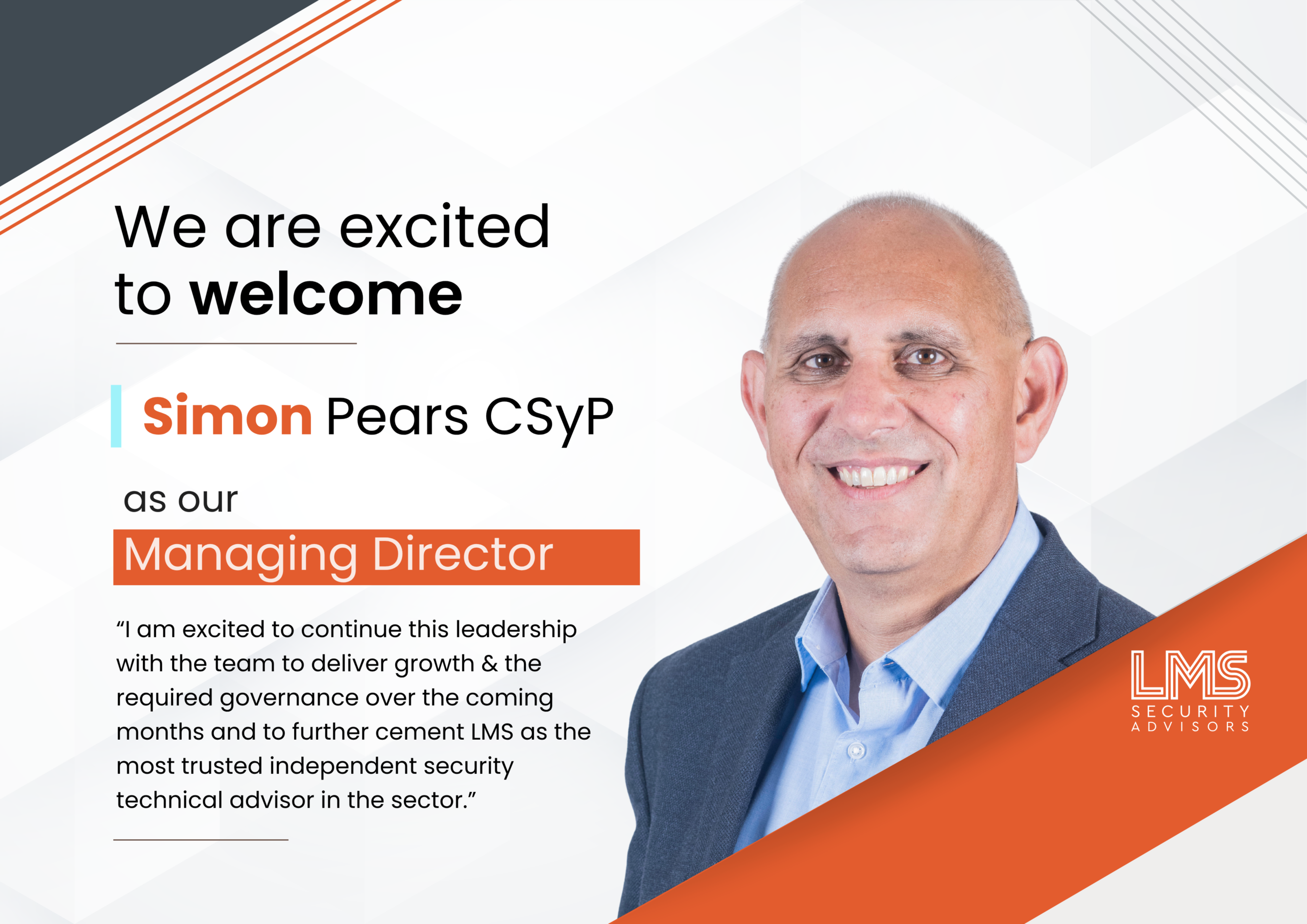
LMS Security Advisors Appoints Simon Pears as Managing Director
Insights LMS Security Advisors Appoints Simon Pears as Managing Director LMS Security Advisors is pleased to announce the appointment of Simon Pears CSyP as its new Managing Director, supporting the company’s continued growth and plans across the UK and beyond. The appointment brings dedicated leadership to LMS at a point when demand for independent technical security advice is growing across sectors, and a need for truly impartial advice and value for money is increasing. Simon arrives with experience of security at a global operating scale. As an experienced Global Security Director, he has built and run high performing security functions spanning multiple regions and environments, working with boards and operational teams alike. He has spent his career translating security into commercial terms that leadership teams can act on. This cements the LMS commitment to knowledge, experience and performance. Simon will lead the business across strategy, client relationships and technical capability, ensuring the advice LMS gives is grounded in real operational experience. For the team, the appointment means investment in moving to the next level. Depth of expertise. Clear standards. Room for people to develop. Simon’s Chartered Security Professional status and his tenure as Chair of the International Professional Security Association, of which LMS is a Founder Member, reflect a long commitment to raising professional standards. This knowledge and experience will now help LMS continue to evolve and enhance its capability for global clients. “Simon brings international experience and a professional standing that our clients will feel the benefit of quickly. He joins at an exciting point for LMS, and I’m looking forward to working closely with Simon and building for the future, both within LMS and with Global Protect.” – Matt Blake, Group Managing Director of SSH(LMS Security Advisors and Global Protect) Simon Pears CSyP, added: “I am truly honoured to be joining the amazing team at LMS Security Advisors which has achieved phenomenal growth under the leadership of Matt Blake. I am impressed with the significant expertise & passion of the team and the genuine positive and respectful culture that is already embedded in the organisation.” Simon’s appointment marks an important step in the continued development of LMS Security Advisors and strengthens its leadership as the business enters its next phase of growth.
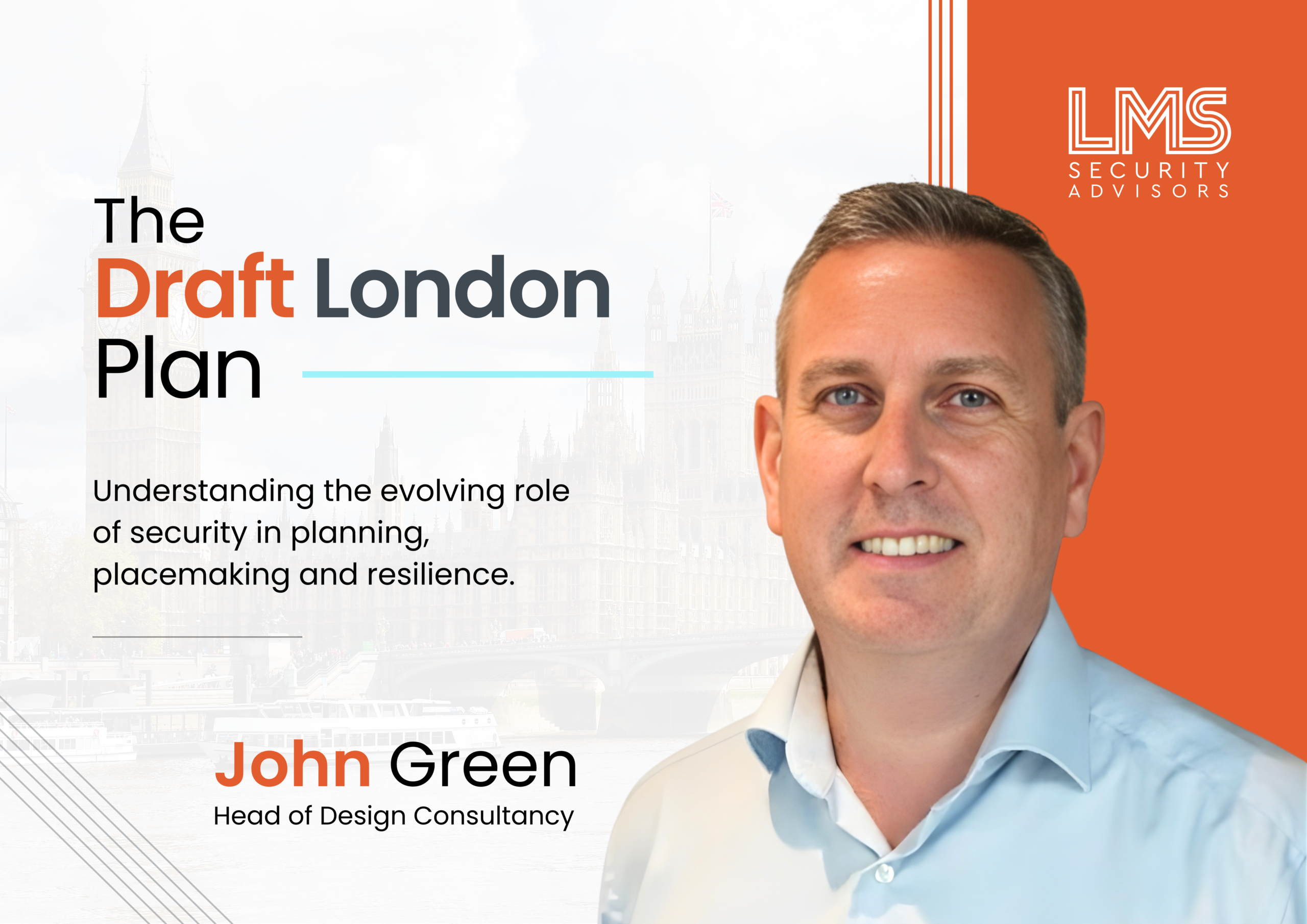
Is the Draft London Plan shifting responsibility for designing out crime?
Insights Is the Draft London Plan shifting responsibility for designing out crime? At LMS, we ensure that all planning adherence complies with national, regional and local level legislation whether this be the National Planning Policy Framework (NPPF) or a local city plan. Our collaborative approach and relationships with developers and planning authorities ensure that our knowledge of all security related requirements is embedded in our methodology for secure and safe places within accessible realm and buildings alike. Having reviewed the Draft London Plan we note a distinct change in requirement wording; a broader ‘security and safety’ framing. Akin to the draft Design and Placemaking Planning Practice Guidance (PPG), this also focuses on safe public spaces, inclusive environments, good movement networks and treats security as a vital component of good placemaking. Where once key words included DOCOs and Secured by Design, CCTV, Access control, Physical Security, HVM etc. the approach is now widened and softened and focused on safe outcomes, public realm quality, healthy streets (i.e. positively used), community safety, resilience and again, good placemaking. Ensuring the safety of women and girls (VAWG) and inclusivity are very much supported and a significant addition to the former policy. The theme embeds a risk management approach, not on prescribing the exact security functions to be specified but more on how and where this is going to be achieved, based on what research and evidence, and proportionally why, without transferring risk elsewhere, emphasising a ‘designing out crime’ methodology rather than moving the problem elsewhere. Are we witnessing the gradual transfer of responsibility for crime prevention from the police to the planning and development industry? For many years, London planning policy has outlined a relatively clear framework. Policy D11 of the 2021 London Plan explicitly referenced Designing Out Crime, counter-terrorism, physical security, electronic security and consultation with Metropolitan Police Designing Out Crime Officers (DOCOs) and Counter Terrorism Security Advisors (CTSAs). However, the Draft London Plan takes a different approach. Security still exists through Policy MBUL10, and engagement with the Metropolitan Police, CTSAs and other stakeholders remains expected. However, the policy is more concise and excludes specific references as before, and places greater emphasis on creating places that are safe, inclusive and resilient through good design rather than through explicit security interventions alone. Is this a weakening of security policy? No. LMS see this as part of a wider trend that is emerging across planning, spreading responsibility across competent specialists that can advise and embed security strategy and appropriate design solutions within the requirements. And this reflects the same approach we take at LMS. The Draft Design and Placemaking PPG, the National Model Design Code, Healthy Streets principles, VAWG guidance and the London Plan itself are increasingly pushing responsibility for ‘safety outcomes’ towards designers, planners, developers and specialist security consultants. The expectation is no longer simply that developments are secure. The expectation is that developments can clearly demonstrate how safety, security, inclusivity and wellbeing have been considered proportionally and balanced from the earliest stages. Historically, planning authorities and project teams have relied heavily on Police DOCOs to review layouts, challenge designs, identify vulnerabilities and advise on crime prevention through environmental design (CPTED), and to this day do still play a critical role in translating crime prevention principles into practical development advice. At the same time, the role itself has become more specialised, with the NPCC formally designating DOCO as a specialist policing function and recognising its growing importance within prevention-led policing. However, anyone actively working in planning and development knows that public resources are under pressure and this includes policing. Availability of specialist crime prevention input is increasingly stretched and the responsibility of providing crime prevention advice and early planning security needs or crime impact assessments is not new to the security consultant family. As demand continues for new buildings, housing and mixed developments, there is also an increase in legislative compliance and a competent necessity for understanding the technological complexity that has increased around us within the past 10 years including the advancement of integrated electronic security systems, drone adaptability, political and socioeconomic threats and the emergence of AI. So is this just more requirement for security consultants to undertake this work? Yes and no. It is not just a matter of propping up support or completing a tick box exercise, this is about understanding what is being asked to demonstrate compliance. The approach moving forward will require a wider remit and justification. The focus is moving away from individual security features and towards broader questions: Does the place feel safe? Does the design reduce opportunities for crime? Are vulnerable groups able to navigate the space safely? Are hostile threats understood? Has operational security been considered? Is there evidence supporting the design decisions? These are not purely policing questions anymore; they are planning questions and design questions. And increasingly, they are security consultant questions. For security specialists like us at LMS, this presents both a challenge and an opportunity. The challenge is that we can no longer rely solely on traditional security disciplines. Understanding planning policy, urban design, placemaking, public realm design, design coding and legislation such as the Building Safety Act and the Terrorism (Protection of Premises) Act, is becoming just as important as understanding the technicalities of Electronic Security Systems and Hostile Vehicle Mitigation. The opportunity is that security consultants are uniquely positioned to bridge the gap between planning, architecture, operational management and protective security. The Draft London Plan is signalling a future where security is not a specialist add-on or tick box chapter within a Planning Report or Design and Access Statement, it is becoming a fundamental component of placemaking. Early doors consultation with experienced security specialists supporting the journey from the start, including before a premises has even been chosen. As that happens, the responsibility for demonstrating how crime has been assessed, how risks have been mitigated and how safety has been embedded within the design may increasingly sit with specialist security design consultants. If planning policy increasingly requires developments to demonstrate how they have addressed crime prevention, VAWG strategy, public realm safety, terrorism resilience, and operational security, then security consultants will need to take a much greater role in providing that evidence

LMS Security Secures Major Government Security Technical Advisory Contract
Insights 21 July 2026 LMS Security Secures Major Government Security Technical Advisory Contract LMS Security Advisors secures major Security Technical Advisory (STA) services contract with one of the UK’s largest government estates LMS Security Advisors, a leading provider of security technical design and assurance services, is pleased to announce the award of a significant contract with one of the UK’s largest Government Estates, the Department for Work and Pensions. The contract reinforces LMS’ position as a trusted strategic partner to the Department, building on an established and successful working relationship. LMS will deliver comprehensive security technical advisory (STA) assurance services across both Business As Usual (BAU) and Project workstreams, providing the Department with the technical expertise and oversight needed to maintain the highest standards of delivery across its extensive estate. This contract win highlights LMS’ continued commitment to supporting UK Government and wider Public Sector on driving value for money and performance across complex estates. Matt Blake, Managing Director for LMS Security Advisors commented: ” We are proud and honoured to be able to continue our work with the Department for Work and Pensions, playing a strategic role in one of the UK’s most significant Government estates. This win is a testament to the quality and dedication of our team, and our passion for driving continuous improvement and value for money. We look forward to working closely with the Department to drive ever higher standards of security that will protect property, assets, and those people who frequently access the Department’s services.” The contract award reflects the growing demand for specialist assurance services within the public sector, where rigorous oversight of both day-to-day operations and major capital programmes is essential to delivering value for money. About LMS Security Advisors LMS Security Advisors is a fiercely independent, privately owned Security Technical Advisor. Our purpose is simple; to protect our clients, their critical assets and investments whilst pioneering innovation and drive up the quality and standards of the Security Industry. We add value to our client’s security functions by understanding the challenges and risks faced by modern organisations and offer technical expertise, assurance and compliance – all delivered by highly qualified and experienced security professionals. For more information contact: enquiries@lmssecurity.co.uk Previous Post

2026, So Far
Insights 7 July 2026 2026, So Far By Matt Blake, Managing Director The first six months of 2026 have been busy, rewarding, and full of reasons to be proud at LMS Security Advisors. As I reflect on the year so far, what stands out most is not just the growth we have experienced as a business, but the people, partnerships, and progress that continue to shape who we are and how we support our clients. From strengthening our certifications and securing new opportunities across critical sectors to investing in future talent and supporting our local communities, there is a great deal to be proud of. None of this happens by accident. It takes a great team, trusted clients, and strong relationships across the industry, and I’m grateful for the role each has played in our success so far. 7 July 2026 2026, So Far By Matt Blake, Managing Director The first six months of 2026 have been busy, rewarding, and full of reasons to be proud at LMS Security Advisors. As I reflect on the year so far, what stands out most is not just the growth we have experienced as a business, but the people, partnerships, and progress that continue to shape who we are and how we support our clients. From strengthening our certifications and securing new opportunities across critical sectors to investing in future talent and supporting our local communities, there is a great deal to be proud of. None of this happens by accident. It takes a great team, trusted clients, and strong relationships across the industry, and I’m grateful for the role each has played in our success so far. Setting the Benchmark for Excellence Maintaining high standards has always been important to us at LMS. Earlier this year, we achieved ISO 27001 certification and successfully renewed both our Cyber Essentials Plus and ISO 9001 certifications. While certifications are often viewed as a box-ticking exercise, anyone who has been through the process knows the amount of work, discipline, and attention to detail required behind the scenes. These achievements are a reflection of the professionalism of our team and their commitment to delivering quality work every day. They also provide reassurance to our clients that the systems, processes, and people supporting their projects meet recognised industry standards. Protecting Critical Environments One of the most positive developments this year has been the opportunity to expand our work across several important sectors. We have bolstered our growth through a number of key new contracts, including public health sector, UK Government and Critical National Infrastructure (CNI). These partnerships further strengthen our role in helping safeguard essential services, people, and nationally significant assets through trusted technical security expertise and assurance. Being trusted to support these environments is something we take seriously. It is a responsibility that comes with high expectations, and one we’re proud to fulfil through the expertise and dedication of our team. Shaping the Future of Security One of the most enjoyable parts of my role is seeing people grow. With the industry needing to do more to attract, develop, and retain good people, I am proud of our Leaders in Security (LiS) Programme as an important initiative for LMS. This year, we welcomed Abigail Clark and Harrison Turner-Robson to the programme. Six months on, both have made a fantastic start. They have embraced every opportunity, asked plenty of questions, and already become valued members of the team and join Jasmine as a potential industry leader of the future. This combined with several of the team developing into more senior roles across the business has seen some great strides for opportunities to advance. Watching that development happen is rewarding, benefiting both LMS whilst also contributing to the future of the profession as a whole. Creating Impact Beyond the Workplace Security is ultimately about people, and that extends beyond the projects we deliver. Through our Make A Difference (MAD) Days initiative, members of the LMS team have continued supporting causes that strengthen wellbeing, inclusion, and community engagement. Most recently, this included volunteering through Disability Sport Yorkshire and supporting wider community activities. It is great to see the LMS team engaging with local communities, reinforcing our ambition to create safer spaces across the UK. At the Heart of the Conversation The security profession continues to evolve, and staying engaged with the wider industry has never been more important. Throughout the year, our team has been actively involvedwith organisations and events including Security Is You(th), ASIS, IPSA, UKREiiF, and The Security Event. These opportunities allow us to share knowledge, strengthen relationships, and contribute to important conversations about the future of security, resilience, and talent development. Looking Ahead When I look back on the first half of 2026, what gives me the greatest confidence for the months ahead is the calibre of the people we have across the business. I’m fortunate to work alongside a team thatconsistently demonstrates professionalism, expertise, and a genuine desire to do the right thing for our clients. I’d also like to thank our clients and partners for the trust they have placed in us and for the opportunities we have had to work together. There’s plenty still to come this year, and I am looking forward to seeing what we can achieve together over the months ahead. If you’d like to learn more about the work we do and how we help organisations strengthen security, resilience, and assurance, we’d be delighted to hear from you. Contact us at enquiries@lmssecurity.co.uk

Strengthening Information Integrity: LMS Achieves ISO 27001
Insights 21 April 2026 Strengthening Information Integrity: LMS Achieves ISO 27001 LMS Security Advisors has successfully achieved certification to the internationally recognised ISO 27001 Information Security Management Standard — reinforcing our commitment to handling sensitive information with structure, accountability, and care. For an independent Security Technical Advisor, information integrity is a fundamental part of our responsibilities. From risk assessments and technical reviews to ongoing advisory support, sensitive information sits at the centre of many client engagements. This certification enabled us to further refine the a framework for identifying, assessing, and managing information-related risks across people, processes, and technology. “Achieving ISO 27001 is a significant milestone for LMS and reflects the standards we hold ourselves to across every part of the business. I’m incredibly proud of the whole team for the work, focus, and commitment that has gone into achieving this high standard.”— Matt Blake, Managing Director Working across sectors including hospitality, financial services, commercial environments, data centres, and the public sector, LMS supports organisations operating in complex, high-trust environments. In these settings, safeguarding information is not just important; it’s essential to resilience, trust, and effective decision-making. This certification reflects the discipline embedded in LMS’s day-to-day operations, from secure information handling and communication practices to maintaining clear audit trails. It provides clients with confidence that their information is managed securely, consistently, and with appropriate oversight.

Quality Assured: LMS Security Renews ISO 9001:2015 Certification
Insights 24 March 2026 Quality Assured: LMS Security Renews ISO 9001:2015 Certification LMS Security Advisors has successfully renewed its certification to the internationally recognised ISO 9001:2015 Quality Management Standard, reaffirming its commitment to disciplined processes, operational consistency, and accountable delivery. ISO 9001:2015 is a globally recognised standard that examines whether an organisation has reliable, structured, and well-managed processes. It reviews how decisions are made, how information moves through the team, how risks are managed, and how improvements are captured. For an independent Security Technical Advisor, these principles directly influence the quality of advice clients receive. Clear processes and effective oversight ensure that recommendations are carefully considered, documented, and delivered with consistency. This renewal confirms that LMS continues to operate within a disciplined quality management framework aligned with recognised international standards. Operating across sectors including hospitality, financial services, commercial environments, data centers and the public sector, LMS supports organisations facing complex physical and electronic security challenges. In such environments, structured internal processes directly underpin the clarity and reliability of external advice. This certification validates the discipline behind our work as independent Security Technical Advisors. From understanding risk and defining scope to reviewing solutions and conducting thorough audits, each stage of engagement is supported by processes designed to ensure accuracy, transparency, and consistency. It also reinforces independence, ensuring that as the organisation grows, its standards remain steady. Ultimately, the renewal provides our clients with continued assurance: that the advice they receive is delivered professionally, consistently and with the operational maturity required to support critical security decisions and to deliver long-term value.